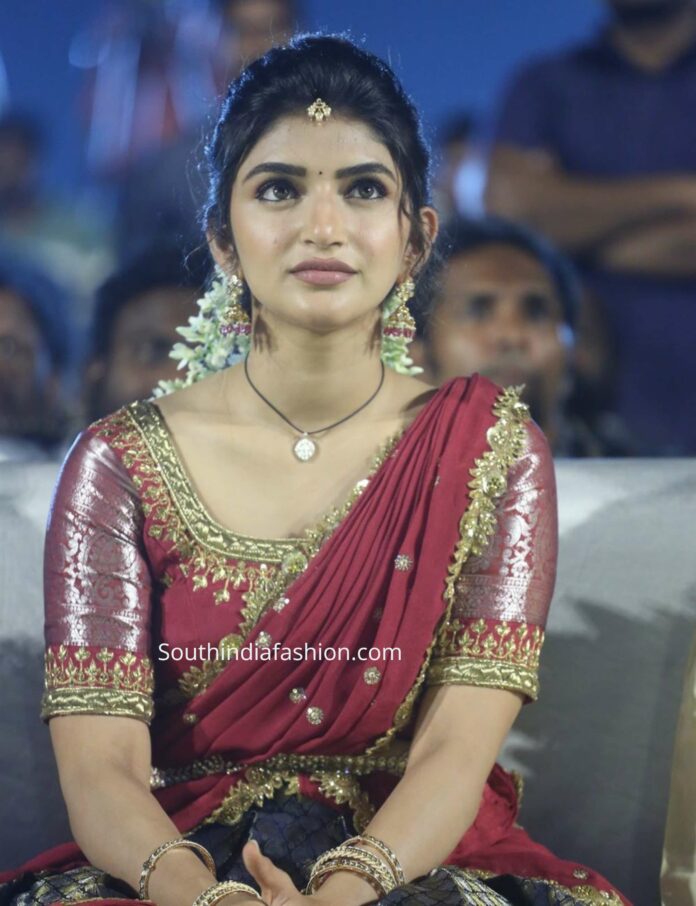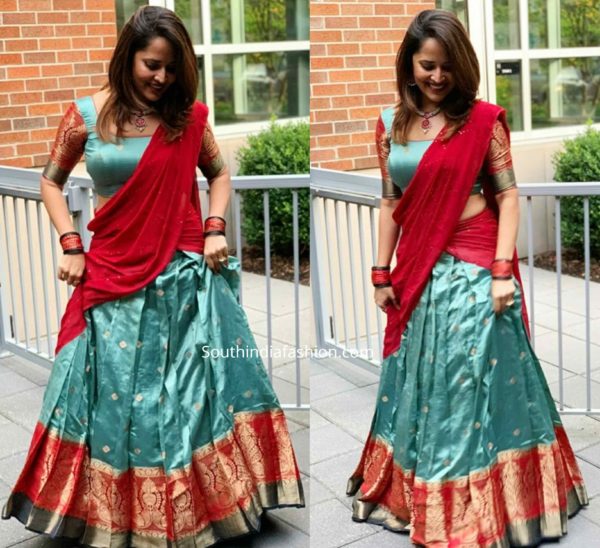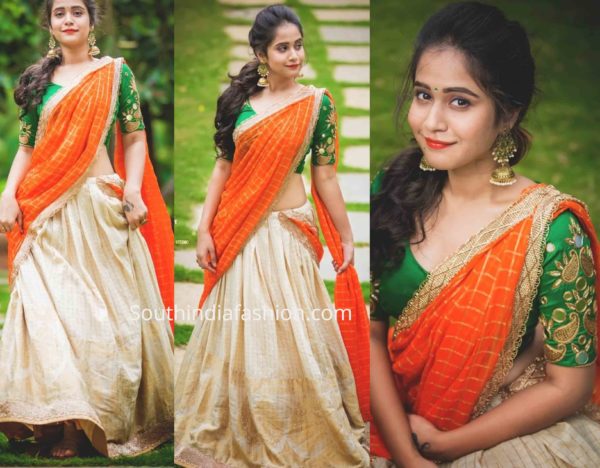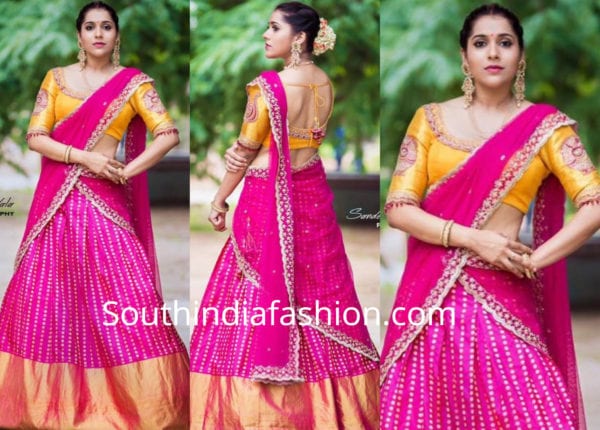
Few outfits say "South Indian celebration" as warmly as the half saree. It is the first silk many girls wear, the pride of a function day, and these days a favourite on pre-release stages and wedding dais alike. This guide explains what a half saree is, what it is called in each language, the styles and fabrics to know, and how to wear it well, with looks from our own archive to show each point.
What is a half saree?
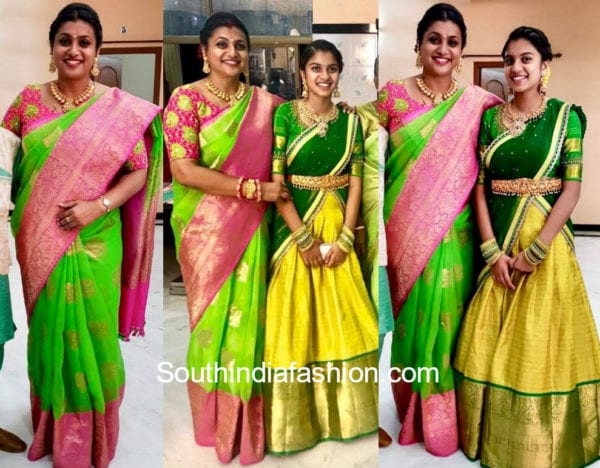
A half saree is a three-piece ensemble: a long skirt, a fitted blouse and a length of fabric (the voni or davani) draped over the shoulder. It gives the grace of a saree without the six-yard drape, which is why it is traditionally worn by young girls and, now, by women of every age for festivals and functions.
The three pieces
- The skirt (langa or pavadai): a flared, full skirt, usually in silk, with a rich border at the hem.
- The blouse (choli): a fitted blouse, often with its own zari or embroidery.
- The voni or davani: a long dupatta-like piece, pleated or draped across the body and pinned at the shoulder.
What it is called
Names change with the language. In Telugu it is langa voni (also langa voni or langa oni). In Tamil it is pavadai davani or pavadai sattai for the younger set. In Kannada you will hear lehenga saree or langa davani, and in Malayalam the set is often a pavada with a kasavu or set-mundu feel. The look is the same family, and the exact words vary by region and even by household.
When is a half saree worn?
The half saree is a ceremonial outfit. It is the classic choice for the coming-of-age function, called the half-saree function in Telugu homes, and for festivals such as Ugadi, Sankranti, Dussehra, Varalakshmi Vratham, Karthigai and Onam. It also suits weddings, pre-wedding rituals and temple visits.
Our archive shows how well it works on festival days. See Sreemukhi's magenta half saree for Ugadi, Ananya Nagalla's green half-saree set for Ugadi, and Sreemukhi's ivory half-saree for Karthigai. For Dussehra, Eesha Rebba's black half saree shows that a festival look need not be a bright one.
[PHOTO: a festive half saree look, from the Sreemukhi Ugadi post]
Styles of half saree
The classic pattu half saree
The traditional version is a silk skirt with a contrast border, a matching or contrast blouse and a voni with a zari edge. It is the safest choice for a family function. Sridevi Vijaykumar's red Kanchi pattu half saree and Kiki Vijay's pink pattu half saree are good references for the classic shape.
The half-and-half saree
Here the voni is cut and stitched in two contrasting colours or weaves, so the drape looks like two sarees joined down the middle. It photographs beautifully and is popular for events. See Divi Vadthya's half and half saree and Madhuri Dixit's purple half and half saree.
The two-tone and multi-colour set
Some sets pair a skirt in one colour with a davani in another, a combination that reads festive and young. Look at Purnaa's green and pink half saree and Sreemukhi's orange and green half saree.
The kasavu half saree
Inspired by the cream and gold of Kerala, this set is the Onam favourite: ivory or off-white with a golden kasavu border. Malavika Mohanan, Anupama Parameswaran and Rashmi Gautam all wore it beautifully, and Keerthy Suresh wore a kasavu half saree to Guruvayur.
[PHOTO: a kasavu half saree, from the Malavika Mohanan Onam post]
The modern or lightweight half saree
Not every half saree needs to be heavy silk. Organza, net and embroidered sets are popular for day events and receptions. See Mirnalini Ravi's grey organza half-saree and Komalee Prasad's red chikankari half saree.
The bridal and designer half saree
Brides and guests now choose heavily worked half sarees with zari, hand embroidery and rich blouses. Browse our edits of designer bridal half-sarees and a designer's signature half-saree collection. Krithi Shetty's red hand embroidered half-saree is a good example of embroidery-led styling.
Fabrics to know
- Kanjeevaram and other pattu silks: the traditional, heavy, lustrous choice for functions and weddings.
- Kasavu cotton and handloom: light, cream and gold, ideal for Onam and warm days.
- Organza: crisp and airy, good for day events and pastel shades.
- Net and georgette: softer drape, often with embroidery or sequins for receptions.
- Kalamkari and block prints: a handcrafted, artistic look. See Hari Teja's kalamkari half-saree and Priya Mani Raj's handblocked beige half saree.
Weaves and finish vary by region and by maker, so check with the seller what the set is actually made of before you buy.
Choosing colours
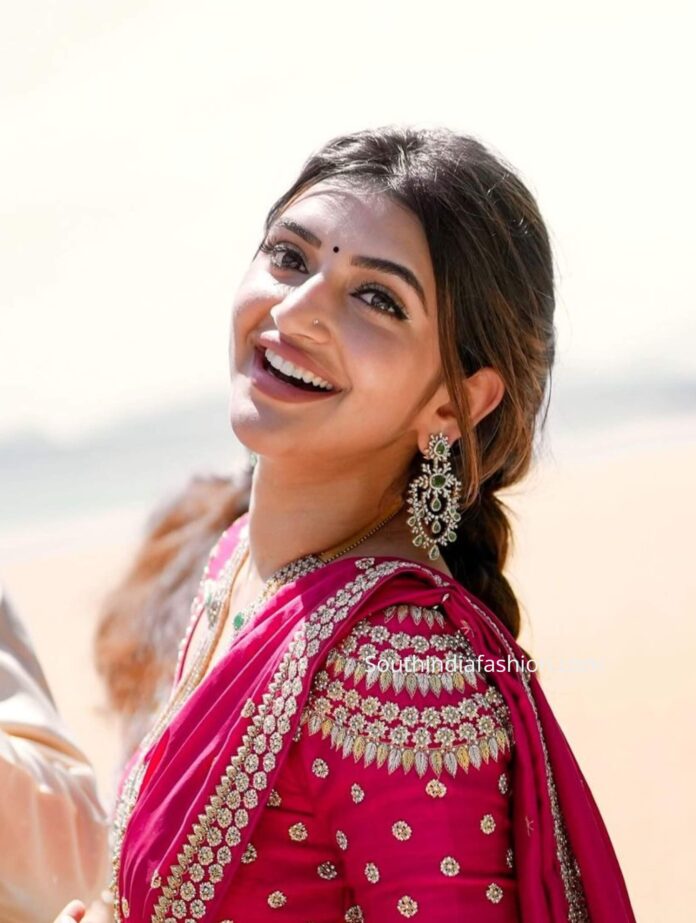
Traditional palettes lean on red, maroon, green, yellow, pink and purple, usually in contrast with a gold border. Pinks and magentas photograph well, as in Aditi Shankar's pink half-saree at the Viruman audio launch and Shraddha Das's magenta half saree. Yellow is bright and auspicious, as in Shivani Rajashekar's yellow half saree and Aishwarya Arjun's yellow half saree. Red remains the bridal and festive classic, seen in Krithi Shetty's red half saree at a pre-release event.
For something less expected, look at the cool tones: Nabha Natesh in turquoise, Athulyaa Ravi in blue, Sneha Prasanna in mint green and Mehreen Pirzada in green. A black half saree, such as Ashika Ranganath's at the Naa Saami Ranga pre-release event, shows how striking a darker palette can be.
[PHOTO: pink and magenta half sarees, from the Aditi Shankar Viruman post]
Blouse and neckline ideas
The blouse sets the mood of the whole outfit. Some ideas:
- Matching blouse: a clean, traditional look; the skirt and blouse in one colour with the voni in contrast.
- Contrast blouse: a bright or gold blouse against a deep skirt adds energy.
- Maggam work blouse: hand-worked beads and thread in a Telugu favourite, ideal for bridal and function sets.
- Elbow or three-quarter sleeves: easy to wear and comfortable for long events.
- Boat, round or square necks: safe, flattering shapes that suit most faces.
For more ideas, see our red silk half saree look, which pairs a classic blouse with a rich skirt.
How to wear a half saree: step by step
- Start with the skirt. Tie the drawstring at the waist, at the height you would wear a saree, so the hem just skims the floor.
- Put on the blouse. Make sure it fits well, since it stays in view all day.
- Take the voni. Tuck one end into the skirt at the waist on the right or left, depending on your family custom.
- Wrap it once around the waist. Bring it across the back towards the front.
- Pleat the rest. Make neat pleats, as for a saree, at the shoulder end.
- Pin at the shoulder. Bring the pleated end over the opposite shoulder and secure with a pin so it stays put through the day.
- Adjust the fall. Let the pallu drop evenly and check the front tuck.
Draping styles differ by region and by family: some leave the voni open and free, others pleat it neatly across. Ask an elder at home for the version you grew up seeing.
Jewellery, hair and makeup
A half saree welcomes traditional jewellery. Temple jewellery, a long haram, jhumkas, a maang tikka, bangles and a waist belt (oddiyanam) are all at home with it. Keep the neckline and the blouse in mind: a heavy blouse needs lighter earrings, while a simple blouse can carry a statement necklace.
For hair, a long braid with jasmine, a low bun with flowers, or soft open waves all work. Makeup is best kept fresh, with a defined eye, a bindi and a soft lip colour.
Half saree for different occasions
Festivals
Festival half sarees favour bright colours and traditional silks. Dussehra, Ugadi and Sankranti call for rich shades; Onam calls for kasavu. For Sankranti inspiration, see Krithi Shetty's pink and yellow half-saree.
Weddings and rituals
As a guest, a half saree is a graceful, comfortable choice. See Sreemukhi's black and yellow half saree at a wedding, Anusree Nair's purple half-saree for a friend's wedding and Sreeleela's pattu langa voni at a wedding.
Film events and stage appearances
Actresses often choose the half saree for pre-release and launch events, because it photographs well and reads as warm and traditional. Sreeleela's purple half saree at a movie launch and Meenakshi Chowdary's green half saree at the Hatya pre-release event are fine examples. The same goes for Vaishnavi Chaitanya at the Baby success meet.
For young girls
The half saree is the classic choice for girls, and it keeps its charm. Sitara Ghattamaneni in a traditional half saree is a lovely reference for a younger wearer.
Tips for choosing and wearing yours
- Mind the weight. A heavy silk skirt is lovely but warm; choose lighter fabrics for hot days.
- Get the blouse fitted. A good fit lifts the whole look.
- Pick a border you love. The border does a lot of the work, so choose it with care.
- Balance the colours. If the skirt is busy, keep the voni calmer, and the reverse.
- Pin securely. Use a safety pin at the shoulder and at the waist tuck, so you can move freely.
- Mind the length. The skirt hem should clear the floor, especially with heels.
Caring for a silk half saree
Store silk sets folded in a soft cotton or muslin cloth, away from damp. Refold now and then so creases do not set in the same lines. Dry-clean heavily worked pieces, and air them after each wear. Care needs vary with the weave and the work, so follow the maker's advice for your piece.
FAQ
What is the difference between a half saree and a lehenga?
Both have a flared skirt and a blouse, but a half saree is finished with a voni or davani that is pleated and draped across the body like a short saree. A lehenga is usually paired with a dupatta worn more loosely.
What is a half saree called in different languages?
In Telugu it is langa voni, in Tamil pavadai davani, and in Kannada langa davani or lehenga saree. The names vary with region and household.
Who can wear a half saree?
Anyone. It began as the outfit of young girls, but women of all ages now wear it to festivals, weddings and events. Choose a rich pattu for tradition or a lighter fabric for a modern take.
Which fabric is best for a half saree?
Pattu silk is the traditional favourite for functions. For warm weather, choose kasavu cotton, organza or a light handloom.
How do I choose a blouse for a half saree?
Choose a well-fitted blouse in a matching or contrast shade, with a neckline that suits you. Maggam work or embroidery suits bridal and function sets, while a plain blouse suits a heavily worked skirt.
Can I wear a half saree to a wedding as a guest?
Yes. It is a graceful and comfortable choice. Pick a colour that does not compete with the bride, and keep the work in proportion to the occasion.